Showing posts with label savings box. Show all posts

6/28/2025

Random Saturday - Piggy banks, part 2

Last week, I posted about the history of the piggy bank and said I would write a second post including some memories of mine, so here I am.

The first money box that I can remember was made from wood. I got it from the bank on World Savings Day.
The World Savings Day or World Thrift Day was established during the 1st International Savings Bank Congress in Milan, a day promoting the idea of saving all over the world.
In some countries it has disappeared completely by now, but in others it is still a tradition on October 31st or, like in Germany, on the last workday before because the 31st is a holiday in some regions. Some banks even have a World Savings Week. Nowadays, the focus of the organizers is on developing countries.
It's not a surprise that Germany still has it, after all we always prided ourselves on being the world champions of saving.
I loved the little gifts we got and even today my tape is still in an (ugly) brown tape holder from that time! Back then, the only option for our little money to go was the savings book. My so-called "youth savings books" in the 70s and early 80s had the appropriate colors and hippie flowers. I wouldn't surprise if I still had them around in a pile of old letters or papers, should I happen to find them, I'll add a picture here.

My money box got broken soon, so I can't show it to you, but I found that exact kind on eBay, in different shapes and with different images, mostly from fairy tales.
While the shape I had is there, the image is not, I'm pretty sure I had Snow White. Who knows, though, maybe it will turn up eventually?
In the bottom it had a metal disk with a keyhole unlike other piggy banks which had - as mentioned in my first post - to be actually broken to get to the money.
Another possibility was having a box which could only be opened at the bank, in the early days bank staff even went to the costumers to open the boxes there.

I still remember that we had a savings cabinet in elementary school. It was smaller than this one in a German pub and stood in a corner of our classroom, probably on a table.

Public domain, picture by Willy Horsch
(via Wikimedia Commons)


I don't remember if bank staff came to the school to open the cabinets, count the money from the little inserts behind the individual slots and add the amount to the "school savings book", but I guess that's how it must have been. If you look at my own book, though, it doesn't seem to have happened very regularly.
I wasn't very good at saving, only once - shortly after my birthday - I had a veritable fortune on my book which I withdrew quickly.
Excuse the look, it's over 50 years old. Also I noticed again that not only my name, but also my address at the time had been filled in incorrectly.


By the way, "Sparefroh", the little guy with a coin for his torso, was an advertising figure which was invented in Stuttgart in 1955 and was obviously still around in the 70s although I can't remember it from anywhere else but my savings book.
He got much more popular in Austria where he is still used today in modernized form.

For those who want to collect money boxes possibilities are endless and it is recommended to restrict yourself to a certain look or material unless your space and financial resources are also endless.
There are the simple piggy banks you have to break - unless you are professionally trained like me at putting a knife through the slot and carefully guiding the coins out -, or those with a key that you or the bank has.
My small size Drumbos (which I wrote about some years ago) would have to be used with a knife.


Collectors also distinguish between "still banks" without mechanics or "mechanical banks" which do something if a coin is thrown in and which are especially sought after in the USA. The first ones were for example made from tin, in the USA also from cast iron.
Hundreds of variations were produced, with music, with counting mechanisms, or with movement.
There are also the vending machines like my Stollwerck "Victoria" (which I wrote about here) which "sold" you chocolate or candy.


My own favorite piggy bank was my safe, though. No idea where it went to, but it probably didn't survive my greedy children's hands trying to get to the Pfennige inside.
As I didn't own any kind of piggy bank at the moment, I treated myself to one for my birthday (yeah, I make the weirdest birthday gifts). The safe from my childhood was grey, but I think I can live with a little color change.
I'm sure my money will be totally safe from burglars now 
😉


Sources:

1. World Savings Day and the Piggy Bank. History and curiosity. On: UniCredit website, October 31, 2023
2. 
Spardosen. Wer den Pfennig nicht ehrt, Spardosen aller Zeiten. On: Kreissparkasse Köln - Geldgeschichte (in German) - also follow the different links at the bottom for more detailed articles and pictures of different kinds of money boxes
3. Jörg Bohn: Spardosen. On: Wirtschaftswundermuseum (in German)

6/21/2025

Random Saturday - Piggy banks, part 1

This post was inspired by another daily thread in my jewelry forum. "Did you have a piggy bank? What did it look like?"
Now doesn't that sound like another great rabbit hole? Because, you know ... I actually had more than one over the years myself. You probably did, too?


Where do piggy banks even come from, though, and why are they called that? After all, not all of them actually look like pigs.

Let's have a look at the history of the savings box, money box, whatever you want to call it.
Would you have thought that they have been around since ancient times?
I found two different informations for the oldest known money box in the world. The first one is on one called a "Thesauros" (or "Naiskoi" according to one source) which is in the shape of a temple and was found in Priene, an ancient Greek town (today on Turkish land), dated to the 2nd century BC.

Money box held at the
Antikensammlung Berlin,
picture taken by Marcus Cyron
,
CC BY-SA 3.0
(via Wikimedia Commons)

Another source, however, says that the Iraq Museum in Baghdad had an even older one in their exhibition in 1990 although it's not clear if it still exists now.
It was found in a private residence in Babylon and was dated to the end of the 4th or beginning of the 3rd century BC. It was thrown on a potter's wheel and looked like an amphora with a slit cut in at the side.
Those easy to make money boxes, which were popular around the world and are still made, had to be broken to get to the money ("break the bank"). You can find a picture of it here.

Earthen pots used in Nepal,
picture by Krish Dulal, CC BY-SA 3.0 
(via Wikimedia Commons)

Over time, money boxes have come in all kinds of shapes and materials, but where does the pig come in?
The oldest piggy bank in Germany is from the 13th century (again there are different opinions about it, in this case about it actually being a piggy bank or just a pig sculpture). 

Then there's the information about one from 1576, but it rather looks as if that story had a satirical background and was then passed on as truth.
Pigs have been a symbol for luck and wealth since ancient times. There are different theories about the reasons. In German, we still say someone "hat Schwein" for unexpected luck, literally "has pig". So it makes sense that a pig would be used for amassing that wealth by saving.

Verified piggy banks from the 12th century were found on the island of Java although these are really wild boars.
I wonder if this one from the 14th/15th century broke from age or if it was broken to get the money out ...

Majapahit terracotta piggy bank,
Trowulan, East Java,

picture by Gunkarta, CC BY-SA 3.0
(via Wikimedia Commons)

In Stuttgart, there's a Pig Museum with over 50,000 items which is an interesting mix of history, art, and kitsch.
Yes, I've been there myself before and was very glad they also had a vegetarian option in the restaurant there.
Of course they also have a few piggy banks behind glass.


Where does the term "piggy bank" come from, though? It's often used for savings in general or for money boxes that don't even have the pig shape.
I wish I could tell you, but again there are different theories. Was there really a clay called "pygg" used to make dishes and pots in which Western Europeans collected their money, so eventually potters started to make "pig banks"? 
Was the word "pig" used for earthenware in general?
So how did the pig get to Germany, for example, where the word is "Schwein"? Did the Germans just translate it? What about the alleged first one from the 13th century then? Which was there first, the "Sparschwein" or the "piggy bank"? 
Is it true that German immigrants helped to make the pig shape popular in the US?
Merriam-Webster tells us the word "piggy bank" was first used in 1917, the Oxford English Dictionary gives us 1913.
Will we ever know? Is it even important?

There is so much more to the history of piggy banks that I decided to stop here and write a second post about this in which I will also be sharing some of my own memories which got triggered thanks to this post.
The post can be found here once it's live.


Selected sources:

1. Spardosen. Wer den Pfennig nicht ehrt, Spardosen aller Zeiten. On: Kreissparkasse Köln - Geldgeschichte (in German)
2. Twisted tail: The great piggy bank mystery. On: BBC. StoryWorks
3. David M. Robinson: Some Roman Terra-Cotta Savings-Banks. In: American Journal of Archaeology, 28(1924),3, pp. 239 - 250 (open access)
4. Hans Graeven: Die thönerne Sparbüchse im Altertum. In: Jahrbuch des Deutschen Archäologischen Instituts, 16(1901), pp. 160 - 189 (in German)

3/20/2022

Nostalgia - Stollwerck's Victoria

Some years ago when I still did the "Finds of the week" posts, I had some called "I'm a collector" in which I shared vintage items. Over time my collections have mostly stopped growing due to different reasons, but they are still there and still loved. I also have vintage items, some inherited, some gifts, some from fleamarkets, some more interesting than others. So I thought it could be fun to share some of them every, now and then and tell their story.

It has been 1 1/2 years since my last nostalgia post, then again I didn't blog much at all in that time.
Today, however, one of my little Steiff teddies told me a story. It seems he went for an adventure and found a large (compared to him) vending machine for chocolate and bonbons in the middle of nowhere!
Unfortunately, the machine was empty and little Teddy was quite disappointed. On the other hand, he had to admit that he hadn't any money on him, anyway, so how sorry would he have been if there had been chocolate but no way to get to it!


Let's take a closer look at this vending machine that Teddy found.
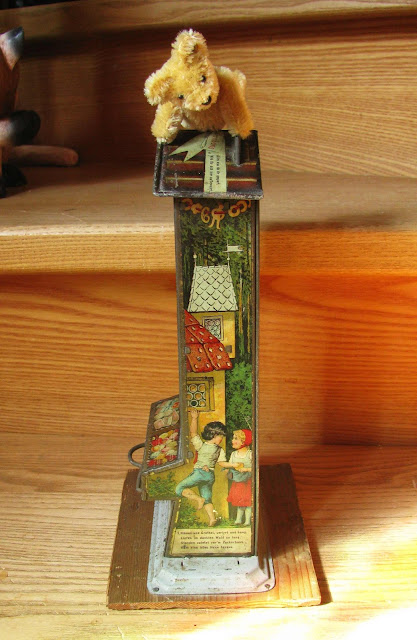
It's the "Victoria Spar-Automat" of the company Stollwerck.
Stollwerck, a manufacturer of chocolate, cocoa, and candy, was the first company to put up vending machines in Germany in 1887. Inspired by their great success, Stollwerck decided to have miniature versions of them produced after 1890 to teach children how to save and to give them an "incentive to diligence". The machines were produced by the company of Friedrich Anton Reiche which was also known for making chocolate molds (very collectible today).

How does the machine work?
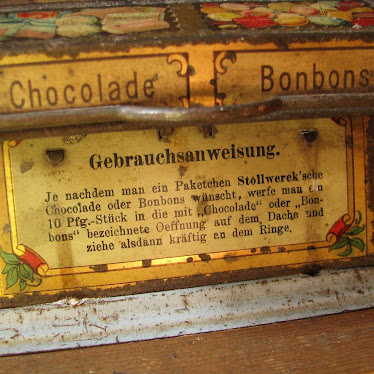
"Victoria" has two chambers that could be filled up with sample boxes of "Chocolade" and "Bonbons".
The house has two chimneys aka coin slots, and depending on the chimney you put the 10 Pfennig coin in, you got chocolate or candy when pulling out the drawer.
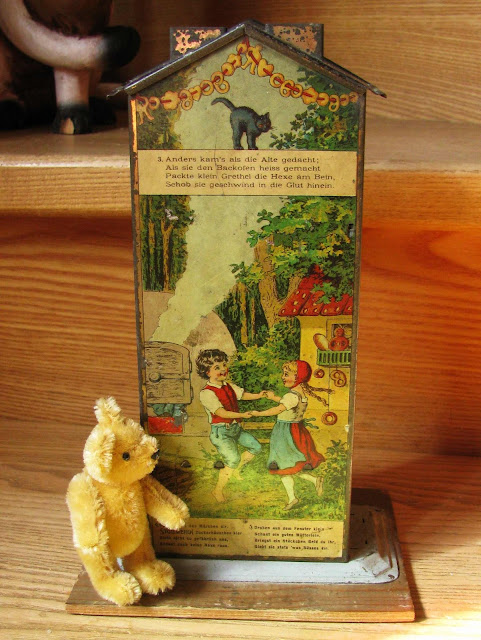
The text says (in German it rhymes): "Save your money, my dear child, throw it in here quickly, everything you save is kept here for you."
The front also says: "Nibbledydee, nibbledyday, what is rattling into my little house?" which of course refers to the coins.


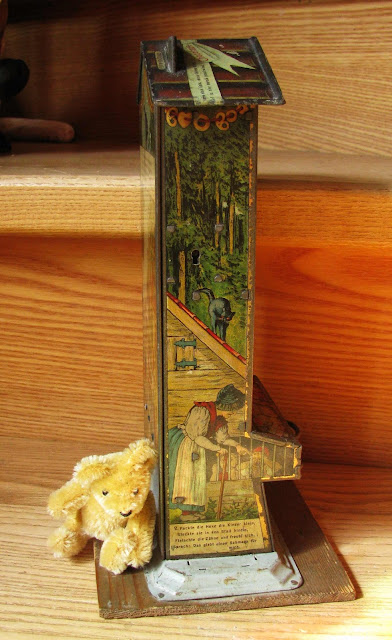
To refill the machine and get your saved money back out, you could unlock it on the side with a little key to allow you to lift off the back and roof.
I wonder how many parents refilled it themselves and how many let the children spend part of their savings on the refills to teach them the value of money.

From the above quote, you can easily tell that the machine is telling us the tale of Hansel and Gretel, with a little twist, however.
You can also see that Teddy has still been very careful not to get himself into trouble!


1. "Hansel and Grethel, lost and frightened, walked so long in the dark forest, finally stood in front of the sugar house, a wicked witch came out."


2. "The witch grabbed the children small, put them into the stable, bared her teeth and rejoiced, said: this will be a feast for me."


3. "It turned out differently than the old woman thought; when she heated up the oven, little Grethel grabbed the witch by the leg and quickly pushed her into the embers."

We know the tale that far, but now comes the Stollwerck twist.

4. "That's what the fairy tale tells you, Stollwerck sugar house here doesn't look so dangerous, no witch is looking out, either."

5. "A good old lady is looking out of the window, if you bring her a piece of money, she will always give you something sweet."


There's one of these machines in our local museum which I had been in love with since I was a small kid.
"Victoria" was produced around 1900 and is a desired collectible, but mine is missing the red bottom stand and has been attached to a metal/wood plate instead which made it affordable enough for me to have my dream of owning her come true.
Now if only Teddy could get his dream of "Chocolade" and "Bonbons" fulfilled, too ...