Showing posts with label Douglas Fairbanks. Show all posts

4/30/2026

Silent movies - The Mystery of the Leaping Fish

I know I had Douglas Fairbanks last week, but this short happened to leap my way - wow, what a bridge to the title 🥳 I have for you "The Mystery of the Leaping Fish" from 1916.


If you take a good look at the theatrical poster, you may be surprised. There are several hints there what the movie is about. "The 1916 Cocaine Classic"?? I guess before diving into the plot, we have to talk about a few things here.
1. This is a Sherlock Holmes spoof. We all know Sherlock has that unhealthy habit which Dr Watson does not approve of. The name "Coke" Ennyday, however, seems more like a joke on the "American Sherlock Holmes", Craig Kennedy, of whose existence I heard for the first time (but promptly put the first novel by Arthur B. Reeve in my vintage crime folder then).
2. 1916 was way before the Hays Code was enforced and even before the Hollywood scandals which first led to the studios to start self-regulating through recommendations Hays introduced in 1924. Dope was also mentioned in other films.
3. Cocaine has a long history of use - Coca Cola, for example, has its name for a reason after all - and only in the 20th century the perception of the drug and its medical uses started to change. The Harrison Narcotics Tax Act which regulated and taxed the use of opiates is from 1914. Unfortunately cocaine in Hollywood also has its history ... and its victims.
4. The story is by Tod Browning, the 1931 "Dracula" director who was known for horror and underworld dramas. "Freaks" is still haunting me, so I doubted this short would be able to beat that.

Now that we cleared that up, we can get to the plot. I need you to not even try to apply any logic to it because there isn't any. No, honestly, don't try.

We meet "the world's greatest scientific detective", Coke Ennyday. Yeah, he doesn't quite look like it, but we know the reason for that.


We even know it more when we see this. No, I don't mean the disguises, but the box standing in front of it.
(And why does the servant remind me of Peter Boyle in "Young Frankenstein", only with a bellboy's uniform that is too small?)


Ennyday is needed by Town Constable Doolittle - because there is a man rolling in wealth with no visible means of support (Doolittle's words, not mine). Very suspicious.


Actually ... literally rolling in wealth which brings Scrooge McDuck to mind although this guy here doesn't swim in coins which looks a lot more comfy.


Guess what, he made all the money being involved in drug smuggling. No, no ... no, stop ... don't ask why they would send Ennyday of all people to check it out ... I told you, no logic!
Ennyday drives to the coast and finds out that the drugs are smuggled via inflatable "leaping fish" (it says they were invented for this film, again, don't ask me, but they do make me think of flying fish and I think they could still be popular today).

Pink-wing flying fish,
public domain via Wikimedia

Just 25 cents an hour to ride the leaping fish personally inflated by the "fish blower" girl (Bessie Love)!


To make it short, using some of his amazing disguises - the meaning of amazing being open for interpretation - Ennyday finds out that the suspicious guy works together with a young lady and some Asian (!!) guys who run the "Sum Hop Laundry" (ouch ... but I learned a new slang word for opium) as a front.


Chaos ensues (plus some sampling of the smuggled goods by Ennyday and the fish blower fighting back very nicely when she gets kidnapped and one of the gang tries to assault her), but in the end all the villains are ready to get picked up by the police and there's a happy ending for Ennyday and the fish blower (it wasn't unusual for characters not to have a name then).


But is that the end of the film?
No.
Because next we are in the office of a scenario editor who tells Doug to give up scenario writing and stick with acting, so Doug and Bessie leave.


The End!


You probably have questions now. I have questions. I doubt anyone has answers, so here's a quote from Fritzi Kramer's blog: "I have some advice: don't ask all these questions. Just sit back, relax and enjoy this bizarre cult classic for what it is."

I have a bit of a thing for the strange or slightly bizarre, for example I'm a Monty Python fan and I love (some) weird cartoons. And like Fritzi also predicted - "it's not a good movie and it's not a good comedy", but I was "unable to look away for even one minute". I went "whoa" and "what the ..." and made noises.
Then I remembered how I once watched a bad animal horror movie with someone and we seriously asked ourselves what the first production meeting for that movie had been like .. as in what did they have for, uhm, refreshments? I had the same feeling here. What was going on?

Lea Stans writes that "for the rest of his life Doug would pretend "The Mystery of the Leaping Fish" didn't exist".
 Yeah, I get that.
I don't regret watching it. I'm just not done analyzing why yet.


Sources and further reading:

1. Fritzi Kramer: The Mystery of the Leaping Fish - A silent film review. On: Movies Silently, October 25, 2015
2. Lea Stans: Thoughts On: "The Mystery of the Leaping Fish" (1916). On: Silent-ology, November 14, 2020
3. Douglas Small: Cocaine: a cultural history, from medical wonder to illicit drug. On: Aeon. Essays. October 4, 2024

4/23/2026

Silent movies - The Matrimaniac

Can you believe it has been more than half a year that I watched a Douglas Fairbanks movie? I know that I said Luke the dog has stolen my heart away from Doug, but that doesn't mean I'm forgetting him completely!
Doug had done a lot of other films before going into the swashbuckling business and today I've got one of those for you - The Matrimaniac from 1916!


Funny, the title is "The
Matrimoniac" here, but in
the film itself it clearly
says "Matrimaniac"!

First the plot (spoiler alert!).

Jimmie Conroy and Marna Lewis want to marry, but her father disapproves and wants her to marry Wally instead, so Jimmie and Marna decide to elope. Unfortunately, Wally witnesses their departure and tells Lewis who makes him go to the train to prevent the marriage until he can procure injunctions.
Wally makes it on the train and confronts the lovers.


As they intend to go through with the wedding, anyway, he wants to send a wire to Lewis, but Jimmie talks to the conductor and hatches a plan on his own. He gets out at the next station to look for a reverend to marry Marna and him. Unfortunately Reverend Tubbs is in the tub. Although he has only thrown on a dressing gown and slippers, Jimmie drags him along, but the train pulls out of the station when they arrive and Wally keeps them from boarding.

Running in a dressing gown and slippers is hard!

From here on, Jimmie does everything to help them follow the train and liberally distributes money and I.O.U.s for clothes for the Reverend, a hand car, and a mule, and finally they hitch a ride on the bumpers of another train.

Tubbs is one dedicated reverend although it's
possible the promise of a donation to 
the church helped a little ...

Meanwhile Wally and Marna have made it to the hotel where the lovers had planned to stay. Jimmie and Tubbs are arrested when they get off the train, but Jimmie escapes.
 
Just look at Wally, the smug little weasel.

He calls Marna, who is trapped in her room with Wally sitting in front of the door in the hallway, and tells her to come to the jail, so Tubbs can marry them.
So now Marna has to come up with a plan of her own. She changes clothes with the maid bringing her food and makes it to the jail where the Reverend tells her that Jimmie has been spotted and is chased.
Marna goes back to her hotel room - a wonderful scene in which she "discovers" Wally talking to the maid in the disguise and plays the betrayed woman - and Jimmie ends up on the telephone wires. He comes to a lineman who arranges a connection between Reverend Tubbs in the jail, Marna in her room, and Jimmie on the pole with him.

"Shut up, can't you see I'm getting married?"

Lewis, Wally, and the police are waiting below and start reading the injunction to Jimmie. Hearing about the marriage by phone sends Lewis running to the jail, but too late.
In the end we see Jimmie in his office paying out to the people he gave I.O.U.s. The last one is good old Tubbs who doesn't just get a bunch of money, but also a kiss from the grateful Jimmie!


With everyone gone, Jimmie opens a safe from which Marna emerges right into his arms.


I knew from a documentary that Douglas Fairbanks didn't start out as a swashbuckler but a stunt comedian in romantic comedies, and had also seen one or the other short scene there. So I didn't really know what to expect exactly, but knew it would be nothing like his big features.
This movie was a fun little introduction to those times. There wasn't much plot beside the chase, but Jimmie and the Reverend made a fine pair (I could have done without the mule scene, but that's mostly because people on smaller donkeys or mules always make me feel uncomfortable).
As Fritzi Kramer puts it, there weren't "any major showstopper stunts", but Doug got a bit of climbing and dangling and jumping in - on walls, over people, from wires and gutters.
I certainly enjoyed it.


Further reading:

Fritzi Kramer: The Matrimaniac (1916) - A Silent Film Review. On: Movies Silently, April 12, 202
6

10/09/2025

Silent movies - Douglas Fairbanks in Robin Hood

I have been a fan of Robin Hood since, well, pretty much forever. My first clear memory is Richard Greene as Robin (did you start singing the tune, too?) followed for example by Errol Flynn, Kevin Costner, Cary Elwes, and Michael Praed/Jason Connery. Of course, there are many more and it looks as if Robin will be living on forever.
There was still one gap I definitely had to fill. Today I have  "Douglas Fairbanks in Robin Hood" from 1922 for you. Yes, it's time for Doug once again and the title was really copyrighted like this to avoid older Robin Hood movies trying to cash in on this movie's success.

Public domain via
Wikimedia Commons


I assume I can keep the plot description short this time and you also won't mind the usual spoilers?
Actually, it won't be that short. Not at all in fact, sorry. Because you see, it takes more than half of the movie - 73 minutes! - until we even get to meet "Robin Hood". The first half is the backstory when Robin is still known as the Earl of Huntingdon.
I'm sure his audience back then was just as surprised as me.

We start at the court of Richard the Lion-Hearted. The King has a bet with his brother John that his favorite, Huntingdon, will win the joust against John's favorite, Sir Guy of Gisbourne and of course he does. Richard announces that the Earl will be second in command on the Holy Crusade. Then he tells him to go and receive the winner's crown from the hands of the fair Marian.
And what's the Earl's reply?
"Exempt me, sire. I am afeared of women." 
That's where it gets a bit weird already.
Of course Richard doesn't care, no matter how often the Earl turns around with a pleading look.


Indeed he encourages all the women to gather round Huntingdon who sees no other way to escape than to jump into the water (the moat, I guess?). The scene is actually quite funny, but it seems a bit out of place, and there's more weirdness to come.


There's a big feast before the Richard and his men go off for the Crusade. You see couples making out in all corners of the castle - only Huntingdon is having fun "trying his strength for the goblet" with the boys, and to be honest, I don't think that comes across as, hm, let's call it manly, as intended.
Richard decides he "should try his love for a maid" instead, has him tied to a post that handily stands around in the hall and summons all the ladies saying "A castle and land to the maid who wins him". They all try their luck except Marian.
The drunk Prince John tells Gisbourne he shall also have his pick of maidens.
Gisbourne forcing himself on Marian catches the Earl's attention, and when Marian runs away and John goes after her, he follows as well and confronts the Prince. Huntingdon and Marian have found their love.


It's time to leave for the Crusade.
Huntingdon orders Little John (then still called the Squire) to guard Marian with his life.
Once the knights are gone - Gisbourne with the task to get rid of Huntingdon and Richard - John goes for it, taxes, torture (the scenes were censored in some areas), all around tyranny.
Marian tries to stand to up to the prince, then she sends Little John as a messenger to the Earl who asks Richard for permission to go home. Richard declines and Huntingdon decides to go anyway, but gets shot by Gisbourne who also lets a falcon loose on the pigeon carrying the message for Marian (how far was that poor bird supposed to fly, I wonder). Richard has Huntingdon and Little John imprisoned.

Meanwhile, John questions Marian's serving woman. Under torture, she tells him about the message, but is set free then and can thus tell her lady that the Prince intends to kill her. Marian and her servant escape by horse and feign her death.
John's tyranny continues while his brother is victorious in the Holy Land.
Huntingdon and Little John have managed to escape, however, and have come back to England where they learn about Marian's death.

"To God - to Richard - and to Her."

"Here began a new life .... - bitter - but joyous." (Huh?)
Yes, Robin Hood is born and it's about time as you will probably agree.


From there on you have all the jumping and skipping and dancing and prancing and merrymenning (I know that's not a word) you can hope for. No, seriously. I guess you just couldn't stop Doug.
And if you thought Errol Flynn invented Robin Hood's iconic stance with the hands on his hips, sorry, he didn't. (Probably Robin even did it in older films.)


We are getting into familiar Robin Hood terrain here now. Taking from the rich, giving to the poor.
He's still missing Marian, though.


Where's Richard, though?
Well, on the way home he escapes being assassinated by Gisbourne, but only because his jester, who has always liked to sit on Richard's throne, slept in his bed at the time.
Then a message reaches him about John's treachery and about Robin Hood. Richard immediately guesses it's Huntingdon and leaves for England.

Now a lot happens rather quickly.
In England, John's men have taken the gold from a nunnery. Robin and his men come to the nunnery where a nun informs Friar Tuck about Robin's real identity and points out Marian to him, and so the lovers are re-united.
Unfortunately, one of John's men witnesses that and tells the Prince. Marian is taken back to the castle and locked up.
John's men are going to Sherwood Forest to capture Robin Hood, expected by the Merry Men, while Robin goes to Nottingham to take over the town together with Will Scarlett and Allan-a-Dale. Yes, just those three.

Three men are quite enough if they know how
to motivate the people to help them, but the next
minute he'll have to go save Marian.

In the forest, an unknown (not to us, right?) knight turns up seeking Robin, "mayhap to join him - mayhap to slay him". He defeats Tuck in a stick fight and is immediately welcome (what?).
Oh, I forgot to mention that Gisbourne is back, too. He secretly takes the key to Marian's room from the Prince, but Marian threatens to jump out of the window if he touches her and she does - but Robin, who has fought his way through, sees her, climbs up the vines on the castle wall and catches her!


Then he kills Gisbourne.
They can't escape easily, though, so Robin, counting on his men, surrenders and gives Marian a dagger to kill herself if needed.
Of course, the Merry Men (and Richard) arrive in time. Huzzah! Richard throws John out of the castle.
The film ends with Robin and Marian being married and retreating to their room - and King Richard banging on the door like crazy.

Okay.
The movie is kind of weird. I have no idea why Fairbanks chose to turn the first half into a bit of a snoozefest because that's what it is honestly. I'm not saying it's a complete waste of time, but it was maybe worth 15 minutes. 20 minutes tops. I'm not the only one thinking that.
The second half, however, is classic Robin Hood, so classic in fact that it inspired later films a lot. Of course it was a great role for Fairbanks to show his acrobatic prowess although he actually hadn't even been sure at all that the story was worth making a film about.
He couldn't do all stunts himself, but it's said that it really was him climbing up the chain of the drawbridge although his brother Robert seemed to have convinced him that it was too dangerous. After rehearsal, however, the double went back to his dressing room and Fairbanks took over without anyone knowing it, thus doubling for his own double.


Even if the second half was a bit over the top with the skipping through Sherwood Forest, I really enjoyed that a lot which was good because I don't think I could have made it through more in the style of the first half.
Fairbanks's Robin was how I imagined Robin Hood, full of energy, and Alan Hale made a great and loyal Little John (a role he played three times, by the way). None of the other Merry Men got their usual stories, they were just there.

Sam de Grasse was a very believable villain as Prince John and Gisbourne was really creepy.
Have you missed the Sheriff of Nottingham, by the way? His role was so small that I wonder why they didn't leave him out completely.

King Richard. He was weird throughout the movie. Wallace Beery (whom I liked a lot better as Challenger in "The Lost World") was big. Everything about him was big, his gestures, his movements, even the way he kept eating all the time, but most of all his laugh. Richard laughed at everything and he kept tilting his head or even his whole upper body back to make the laugh so big, you could almost hear him (again I'm not the only one who thought that).
I found him so annoying, also his obsession with Huntingdon until the end. What kind of ending was that, having Richard banging on the door like an idiot? Did Richard want Robin to be with Marian or was he jealous of her in some weird way? After all, he had been the one insisting on him finding a maid to love.

Leave them alone, Richard, they got better things to do!

Let's talk about Marian (who wore the most interesting costumes, just like some of the other ladies, all those patterns!).
At the beginning, Marian isn't the typical damsel in distress. She speaks her mind very clearly when she refuses Gisbourne's advances, she speaks out against the Prince about the way he treats the people, and when threatened by death, she's smart enough to fake her own death before retreating to a safe space. Even later, she's not afraid to rather jump out of the window than to give in to Gisbourne.
Then Robin turns up and suddenly Marian is the damsel in distress, gasping and shielding her eyes. I thought that was very unfair.

The production design was, well, wow.
That huge castle made me feel immediately old because I kept wondering how you would even try to heat something like this, especially with all those open windows, and that long staircase reminded me of my youth and a similarly long staircase which I hardly managed to climb even then.
Seriously, though, it looked amazing and of course gave Fairbanks ample possibilities for stunts. I love his stunts and I love how joyful he manages to look when doing them. Doug Sr. was not as good-looking as his son, but when he laughs, I forget about that.

So did I enjoy the movie? Overall yes, I did. Could it have been better? Yes, I think it could have. A lot less backstory, a lot less of Richard exaggerating, a bit less skipping, and a bit more of the Merry Men.
Still, I can imagine watching this one again. With a bit of fast forwarding here and there
 😉


Sources:

1. Allen W. Wright: Douglas Fairbanks in Robin Hood. 1922 Silent Film. On: Robin Hood - Bold Outlaw of Barnsdale and Sherwood. October 2022
2. Erik Lundegaard: Movie Review: Robin Hood (1922). On: Erik Lundegaard. February 12, 2010

6/05/2025

Silent movies - The Black Pirate

A little over three months ago, I started my silent movie adventure with Douglas Fairbanks's "The Thief of Bagdad". Nizzy Noodle! Who would have thought I'd actually get that far and haven't tired of it one bit yet?
I think three months have been enough for me to allow myself to come back to another Fairbanks adventure. This time we dive into the world of pirates, arrrr (sorry, but I think I have a legal obligation to say that at least once in a post about pirates).
The Black Pirate from 1926 has not been the first pirate film by far, but I think it's safe to say that it has definitely set standards and inspiration for following films because it had everything you could pack into a swashbuckler.

Public domain via
Wikimedia Commons


Let's get to the plot first (with spoilers as usual).

The film starts with pirates mercilessly looting a captured ship and blowing her up with the travellers and crew on board.
Only two men, father and son, get washed up on an island. The father dies and the son takes his ring and vows to revenge him.
The pirates too come to the island to bury part of the treasure, and the pirate leaders get ready to kill the others to keep the secret.


That's when the son appears asking to join them. To prove himself, he fights the pirate captain and kills him. When the pirate lieutenant says there is more to being a pirate than swordplay, he claims he will be capturing the next ship single-handedly - and he does.

To prevent the passengers and crew getting killed, he suggests holding the ship for ransom. When a lady and her maid are also discovered on the ship and the lady is claimed by the pirate lieutenant, "The Black Pirate" says they will be holding the "princess" as hostage for ransom as well, but she has to be unharmed, not exactly what the lieutenant had in mind as you can tell by his look from the background.


Actually, our hero has fallen in love with at her at first sight and intends to bring her ashore which he also lets the captain of the captured ship know. He also tells him also to send "my best soldiers" and gives him his father's ring. I mean, we have suspected from the start that he's no ordinary guy, right?

The pirate lieutenant, however, has ordered one of his crew to go on the ship and blow her up, so she can't return, therefore "The Black Pirate" won't be made captain, and he'll get the lady for himself.
When the ship doesn't return with the ransom, "The Black Pirate" is forced to walk the plank, but with help of the lady and MacTavish, one of the pirates who has become loyal to him, he survives and goes ashore to get help.

He returns just in time before the lady meets a terrible fate, and his troops overpower the pirates.
The Governor reveals him to be Duke Arnoldo in reality, and he asks the lady, who is in fact a princess, for her hand in marriage.

It is said that Mary Pickford was jealous and that it's her in this kissing scene.
There is archival footage of her in the costume, so it's well possible it's true.
Please also note that "The Black Pirate" had changed from his wide pants
(see first picture) into shorts as soon as he joined the pirates.

First of all, let me say I have never been a big fan of pirate movies. I don't like fight scenes with a lot of people and having all of them on a ship plus cannons, a lot of swords, ropes, and sails doesn't make it any better.

In "The Black Pirate", however, there aren't loads of mass fight scenes. We have one big one at the end although that didn't impress me as much as the "uniforms" of the troops? Not sure that's the right word.
Once again I'm getting ahead of myself, though.


Fairbanks had been wanting to make a pirate film for a while, but he said he "could not imagine piracy without color".
Indeed, this was the first major feature film to be shot completely in Technicolor where before there had only been sequences. If you hear that, you probably think rich and colorful, but at the time they only had "two-strip" Technicolor which captured just the reds and the greens.
As you can imagine, the process wasn't cheap and called for someone who didn't just like to try out new things, but also had the money to do that.

Fairbanks didn't want the novelty of color to distract the audience from the plot itself, though. So they settled for a muted color palette and all items would be dyed to show the proper color on screen if necessary. Lighting affected color as well and there was a dual set of costumes for artificial and (mostly) natural light.
You may not get the feeling of a real color film off it, but actually I thought it works well with the atmosphere.

The plot was quite straightforward. I said it had everything, but this time there were no huge effects or sets, also due to the costs of Technicolor, it was all in the story.
You had the sword fights, the damsel in distress, betrayal and intrigue, loyalty, humor, and of course the acrobatic stunts Fairbanks was known for.
The biggest stunt which has been replicated more than once was of course The Black Pirate riding down the sail by plunging in his knife into it and slicing it during the ride.
 There have been different theories on how this stunt was made (see the sources), but who needs to know? It's just amazing to see him do it, we don't have to analyze everything.


The plot was perfect for the length and I was neither bored nor did I get overwhelmed by fight scenes.
The chemistry between The Black Pirate, his loyal companion MacTavish (who also added a bit of comic relief), and the evil pirate lieutenant worked really well.
I can't necessarily say the same for the romance, but that didn't surprise me. The typical damsel in distress is just that - distressed. She doesn't get to do much more than feel faint or desperate until she gets to be happily in love in the end.
At least our princess 
quite cleverly managed to slip The Black Pirate a knife when he was about to walk the plank with his hands tied up.
So yes, I enjoyed myself much more than I had expected from a pirate movie and I would really recommend watching it.


Sources:

1. Fritzi Kramer: The Black Pirate (1926) - A Silent Film Review. On: Movies Silently, July 16, 2017
2. Jeffrey Vance: The Black Pirate - Essay. On: San Francisco Silent Film Festival (A Day of Silents 2015)
3. The Black Pirate (1926). On: The Chasbah, February 3, 2024
4. Carl Bennett: The Black Pirate (1926). On: Silent Era
5. Tracey Goessel: The Black Pirate. On: Library of Congress, National Film Preservation Board

3/13/2025

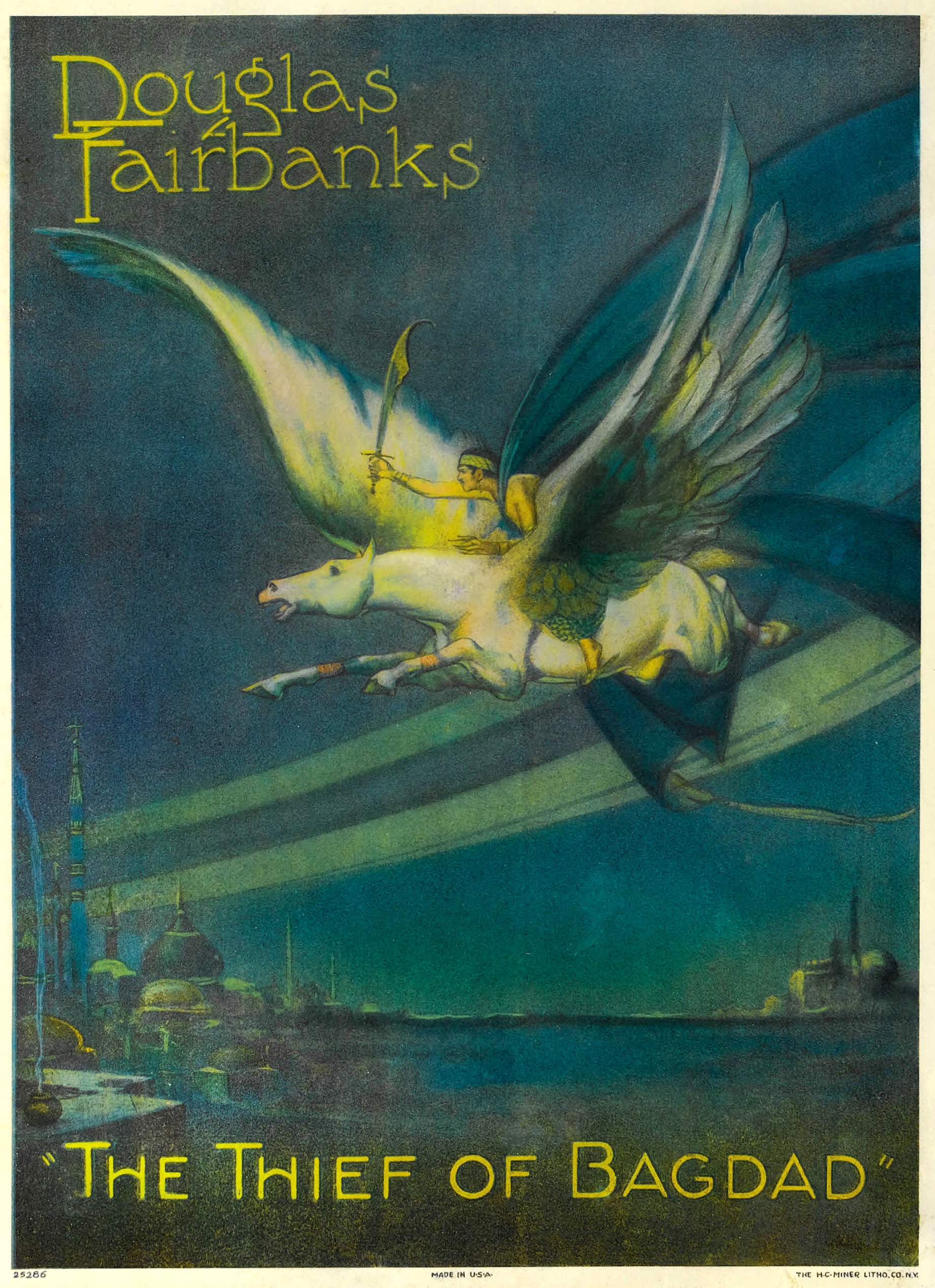
Silent movies - The Thief of Bagdad

As announced in this post , I have started my silent movie project now, quicker than even I had expected.

For my first movie, I chose "The Thief of Bagdad" starring Douglas Fairbanks sr, directed by Raoul Walsh.
When I wrote about the movie "Sinbad the Sailor" from 1947 with the junior, which is very much regarded a homage to his dad, I said I would watch the 1940 version of "The Thief of Bagdad" next (maybe for another post) and possibly the 1924 silent movie as well. That was before I decided to
fight the decline of my attention span and include silent movies in the process. So the "maybe" became a "definitely" although my first attempt was quite feeble. It was a very tired day and I had to abort the mission after 20 minutes because I literally couldn't keep my eyes open to do anything at all except fall asleep within seconds.

Public domain via Wikimedia Commons
(Anton Grot)


New day, new luck.
There are several versions of the movie on YouTube, restored, unrestored, different resolutions, different music. At first, I chose randomly and ended up with a kind of ethereal and repetitive music which may not have helped me fighting my eyelids.
The second time I had a look around and chose this one with the original Mortimer Wilson score.

2 1/2 hours and much to my own surprise I didn't struggle with it although I'm going to say from the start that the movie didn't need to be that long in my opinion.
I had to take one little break because the cats were at the brink of starving and got very dramatic about it. They would have done great at silent movies (they rarely get really talkative and as they were about to be dying on the spot, their voices had gone completely).
Right after the movie, a short video with Leonard Maltin, well-known and respected film critic, popped up. He said: "'The Thief of Bagdad' is just a glorious film, but sometimes misunderstood because Douglas Fairbanks plays it so big. His gestures are so big that people sometimes laugh at him, and I say 'no no, don't laugh at him, laugh with him, he's doing it on purpose, he's doing it like ballet. ... But everything about that movie is big. The other reason he thought of doing it that way was that he didn't want to be eclipsed by the sets and the special effects. He still wanted it to be a Douglas Fairbanks movie."
That had been my thought. It was like a ballet on screen with Fairbanks as the main dancer who seemed to enjoy himself a lot.

The plot of "The Thief of Bagdad" may sound familiar to you in parts.
Fairbanks is Ahmed, a thief in Bagdad (didn't expect that, did you?) together with a friend. With the help of a magic rope he has stolen in the marketplace, he enters the palace of the Caliph of Bagdad to steal a treasure from there, but when he lays his eyes on the Caliph's sleeping daughter, he falls in love and leaves the palace only with her shoe for a souvenir.
His friend is confused about the shoe at first, but then understands what has happened.

My favorite intertitle.
I wonder what people are going to think if I add
that to my repertoire, maybe for a work meeting -
Nizzy noodle! No idea what it means
.


So he tells Ahmed the story of a princess who got "stolen" from a palace after being drowsed (not cool, guys).
To gather entry to the palace, Ahmed and his friend - in stolen finery - join a group of three princes, the Prince of the Indies, the Prince of Persia, and the Prince of the Mongols who really wants to conquer Bagdad. The Princess is supposed to choose a husband among them. Of course it's love at first sight for her when he rides into town.
He climbs up to her room, but finds he loves her too much to go through with the plan and take her away. Before he and his friend can leave the palace, though, the princes are summoned to learn that the Princess chose Ahmed.
Unfortunately, the Princess' Mongol slave recognizes him as the thief from the night before, and understandably being on the Prince of the Mongols' side, she lets him know, just when Ahmed has confessed to the Princess. Ahmed is flogged and supposed to be killed by an ape, but the Princess bribes the guards to let him go.
To delay the wedding with one of the three princes, she has her father send them out and the one bringing the rarest treasure will be her husband.
Ahmed, too, hears of this and sets out himself. With the help of a hermit during his dangerous travel - fire, the deep sea and monsters - he finds a winged horse taking him to a place where a magic chest is hidden under a cloak of invisibility.
The Prince of Persia finds a magic carpet, the Prince of the Indies a magic crystal, and the Prince of the Mongols a magic apple which can heal. He has ordered the slave girl to poison the Princess, so he can heal her and thus win her hand and the throne. To be on the safe side, he has managed to station 20,000 of his men inside the town.
When the princes see in the crystal that the Princess is near death, they take the magic carpet to get to Bagdad where the apple heals her just in time.
Just when the Mongol Prince has taken the throne thanks to his army and orders the wedding to take place immediately, Ahmed reaches Bagdad and uses the magic chest to create an even bigger army which makes the Mongols flee.
Before their prince can escape on the flying carpet with the Princess as suggested by the slave, however, Ahmed, invisible thanks to the cloak, rescues her.
In the end, they fly away together on the carpet.

This is a fairy tale (the subtitle
"An Arabian Nights Fantasy" could have hinted it that). So I didn't quite get one review saying it left the viewer lukewarm because she's not a fairy tale person. To be honest, I think if I wasn't, I wouldn't even have tried to watch this.
Then there is of course the question of Orientalism which was to be expected for a story inspired by "Arabian Nights" and made in these times.
In fact there were protests when Fairbanks and his wife Mary Pickford visited Shanghai on a world tour in 1929, due to the controversy about the portrayal of the Mongol Prince (not the only film of the time seen as controversial in China), which then led to Fairbanks declining public receptions.
Here is an interesting article about a collection of "film posters creating an Orientalist fantasy", by the way. This post led me from one big rabbit hole to the next.

I don't know if the reason is that it is a fairy tale, but to me it was not as extreme as for example Gunga Din or The Sun Never Sets.
The villain was Mongol, yes, and I don't know why they chose those three countries for the princes or if they even gave it much thought at all, but he was a conqueror who wanted Bagdad, and real life white conquerors have shown us they could do much worse, so the movie certainly didn't make me think of him and all Mongols as the epitome of evilness afterwards.

Let's go back to talking about "big ballet".
As I said, Fairbanks was the main dancer and acrobat and if you are able to take this as a fairy tale ballet and can get over the expressive overacting of a silent movie - something I had to learn first myself - it's really enjoyable to watch his big arm gestures and "dancing".
So he may have been too old for the part at 41, but without looking at his face you wouldn't have guessed it seeing him jump and climb his way through the movie and through the first part of it even without a shirt (I much preferred his look to huge muscles).


Can you imagine what it must have been like to watch something like this back then? It must have been magical, even to Fairbanks himself whose favorite it was according to his son.
There are reviewers who find the movie aged. I get that silent movies are not everyone's cup of tea, but how can you even compare them to new/er ones?
Another one lets us know that it's obvious all the monsters are fake. Seriously?! So glad he told me!

People, that movie is 100 years old. Of course it's aged and has obviously fake monsters (show me a movie that has real ones, doh) and still it's able to enchant a lot of people, me included.
There was some fine acting, for example from Anna May Wong as the slave - better than the Princess who mostly had to swoon over Ahmed a lot - and
Sôjin Kamiyama as the Mongol Prince.
Could the monster fights have been a bit longer and the love-birding a good deal shorter? Yes. Could the army scenes have been a bit shorter? Yes. Even if I know not everyone agrees, - rabbit hole - the movie still didn't put me to sleep, not even Ahmed's inevitable transformation from thief to good person to prove himself worthy for the Princess.
Is it a movie I will want to watch over and over again? No. Do I see myself watching it again at all sometime? Absolutely.

Now let's get to the other big star.
The movie may have been a critical success, but it was not a commercial one because of the costs.
It was one of the largest and most expensive movies made until then costing the incredible sum of $1,135,654.65. I wonder what the 65 cents were for
😉
That is really not that surprising if you look at the sets. They are huge and you wouldn't know that just two years before they started out as Nottingham Castle in "Robin Hood" before production designer William Cameron Menzies transformed them to Bagdad by massively extending them.
You have to see it yourself to get an idea.
I found myself wondering how they made the fabric for the long curtains in the palace and how you wash something like it. I also noticed being fascinated by some of the costumes (possibly not the ones you are thinking of now).

Also there are of course the special effects - not just the fake monsters. I loved the scene with the sea spider, the flying carpet, the little "whirlwind" indicating the invisibility cloak, the effects were so good for that time. I would have loved to be in an audience back then to see the reactions.
Of course you already know that I'm old-fashioned and sometimes prefer those effects to today's super effects even if some come across as a bit ridiculous.

I almost forgot to say something about the music. As mentioned, I chose the version with the original score. Fairbanks had already worked with Wilson on "The Mark of Zorro" and therefore commissioned him to write a score for "The Thief of Bagdad" with the instruction to "make your score as artistic as you can".
In the 80s, the movie was shown with a musical score by Carl Davis based on compositions of Rimsky-Korsakov and you can also find this version on YouTube, but I really liked the original music a lot and I like the idea that this was what the original audience got to hear.

You are probably more tired now from reading this than I was from watching the movie.
So yes, if you are ever game to watch a silent movie, why not try this one?
In the sources I have collected some more articles and reviews on this if you haven't read enough yet and I made it a mix of positive and not so positive ones. In the end, you always have to make up your own mind, anyway.

I also hope you are not scared now to follow me to my next silent movie adventure. The list is growing slowly ...

Sources:
1. Jeffrey Vance: The Thief of Bagdad. An essay on "San Francisco Silent Film Festival" 2013
2. Darragh O'Donoghue: The Thief of Bagdad. On "Senses of Cinema", issue 84, September 2017
3. Kirsten O'Regan: Aladdin to Thief of Baghdad: How film posters created an Orientalist fantasy. On "Middle East Eye", May 15, 2019
4. Reviews of "The Thief of Bagdad" on Letterboxd
5. Kage Baker: Ancient Rockets: The Thief of Bagdad. On "Reactor", August 10, 2009

6. Craig Lysy: The Thief of Bagdad - Mortimer Wilson. On "Movie Music UK", August 8, 2022